There is a moment that comes to every boat owner. You want to fit something — a light, a grab handle, a camera mount, a solar panel — and you find that the only place it can sensibly go is a moulded headlining, a locker side or a section of deck with absolutely no way of getting behind it. No access for a nut. Nothing solid to bolt through to.
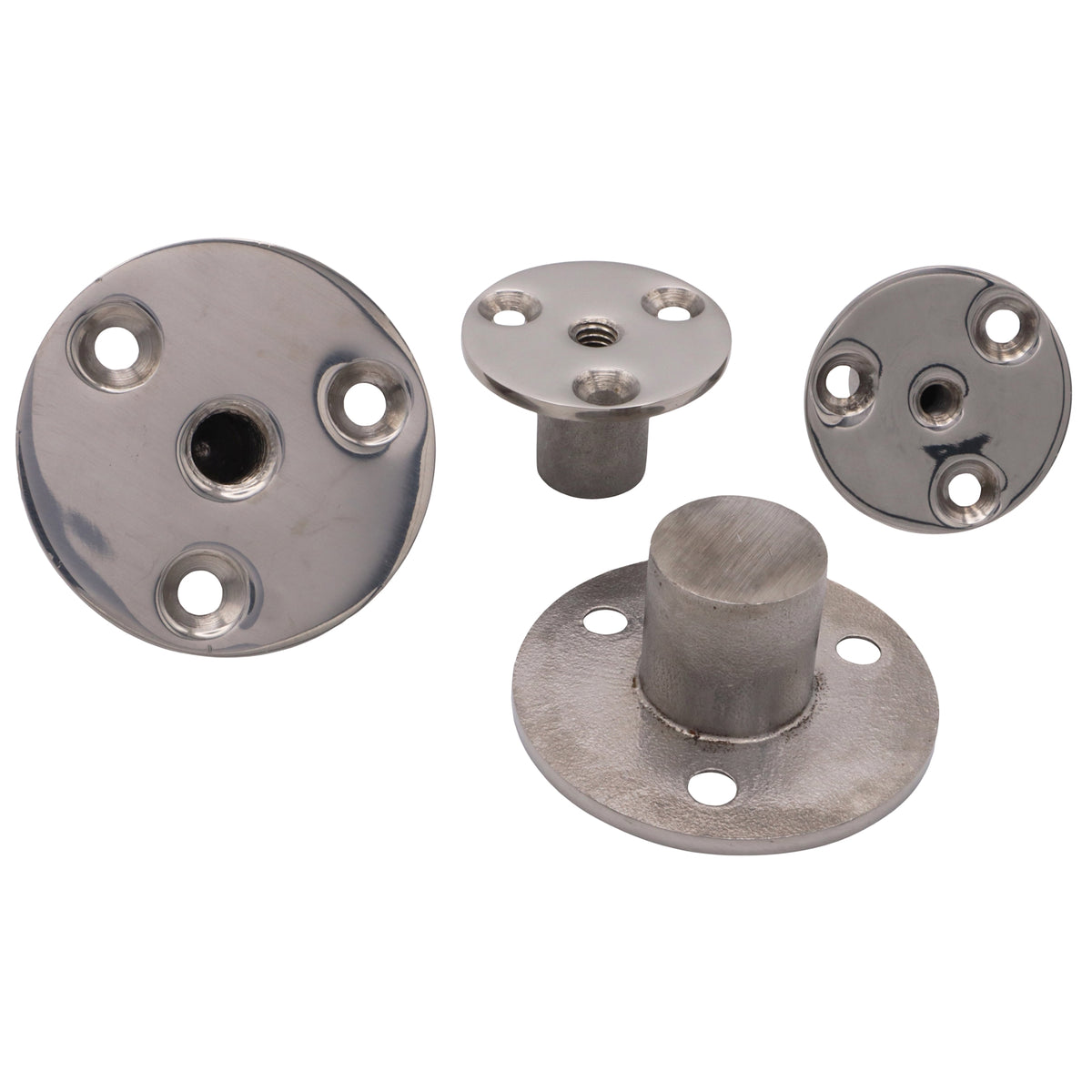
A threaded mounting point solves exactly this. It is a small 316 stainless base plate with three countersunk screw holes and a machined thread in the centre. You screw the base down onto the surface, and you are left with a clean, strong metric thread facing outwards. Anything with a matching bolt or stud can now be attached — and removed again whenever you like.
They are a genuinely useful bit of kit, but they are also one of those products where the uses are not obvious until someone lists them out. So here are ten.
What Makes Them Useful
Before the list, it is worth understanding the three problems these fittings actually solve, because that is what tells you when to reach for one.
1. They Are A Blind Fixing
No rear access needed. This is the big one. Headlinings, hull liners, moulded furniture and cored decks are all places where a conventional nut and bolt is either impossible or means dismantling half the boat.
2. They Make Fittings Removable
Fit the base once, then bolt things on and take them off as often as you like. When the fitting is off, all that remains is a low-profile stainless disc rather than a set of empty holes.
3. They Put The Thread Into Steel
Fibreglass, plywood, foam core and thin aluminium will not hold a machine thread for long. The base plate spreads the load across three screws and puts the thread where it belongs. If the thread is ever damaged, you replace a small fitting instead of repairing the boat.
Ten Uses For A Threaded Mounting Point
1. Camera, Phone And Tablet Mounts
Action cameras, phone cradles and chart plotter tablets nearly all mount on some form of ball-and-arm bracket, and those brackets almost always terminate in a metric bolt. An M6 mounting point on the coachroof, the cockpit coaming or the wheelhouse roof lining gives you a solid base for one — and lets you take the whole lot off and lock it in a locker when you leave the boat.
2. Grab Handles And Hand Rails
Interior grab handles very often need to go on a moulded surface with no access behind. Two mounting points at the correct centres, and a handle bolted between them, gives a far more secure result than screws driven straight into a thin GRP moulding.
3. Cockpit And Saloon Tables
A table that is only wanted at mealtimes is much better on a removable pedestal than a permanent one. A mounting point in the cockpit sole means the table goes up in seconds and the sole is left clear and flush the rest of the time.
4. Sunshade, Awning And Boom-Tent Poles
Awning poles need a foot to locate into and guy lines need somewhere to pull against. Mounting points at both ends give you a proper fixing for the season that disappears completely when the shade comes down in the autumn.
5. Solar Panel Brackets
Rigid panels are usually fitted with corner brackets that want an M6 or M8 bolt. Mounting points let you fix the brackets to a coachroof or bimini frame without drilling through into the headlining below — and let you lift the panels off for winter storage or for access to the deck beneath.
6. Lashing And Tie-Down Points
This is the one we would push hardest. Screw an eye bolt into an M8 or M10 mounting point and you have created a secure anchorage point anywhere you want one. Jerry cans, gas bottles, spare anchors, dive tanks, tenders on the foredeck, a cool box that keeps sliding across the cockpit — all can be strapped down properly rather than wedged and hoped for.
7. Rod Holders And Bait Boards
Fishing gear tends to arrive at the boat in quantity and leave again at the end of the day. Mounting points along the gunwale or on the transom let rod holders, bait board arms and rack systems be fitted for a fishing trip and removed for everything else.
8. Deck And Cockpit Lighting
Courtesy lights, cockpit floods, spreader lights and LED strips all need mounting brackets, and lighting is very often retrofitted to exactly the kind of moulded surface you cannot get behind. An M6 mounting point does the job neatly.
9. Dinghy, Kayak And Paddleboard Chocks
Cradles and chocks on the coachroof or foredeck are only wanted when the tender or the boards are aboard. Bolting them to mounting points means the deck goes back to being clear deck the rest of the time, with nothing to trip over and nothing to catch a sheet.
10. Equipment Inside Lockers And Bilges
Bilge pumps, battery boxes, chargers, filters, fire extinguishers and first aid kits all need mounting, and locker sides and bulkheads are frequently thin, awkwardly shaped, or backed onto a void you cannot reach. A mounting point gives you a proper machine-threaded fixing instead of a self-tapper that will eventually work loose.
Which Size Do I Need?
Our threaded mounting points are available in M6, M8 and M10. As a rough guide:
- M6 — camera and phone mounts, ball-mount arms, cockpit speakers, LED and courtesy lights, instrument pods, cup holders, cable runs, small solar brackets
- M8 — the general-purpose size. Grab handles, rod holders, solar and antenna brackets, bimini and hood eye ends, fender baskets, table pedestals, gas bottle and jerry can strapping points
- M10 — load-bearing work. Lifting and lashing eyes, tender and outboard lashings, dive tank racks, davit stays, snubber and preventer anchorages, heavier awning frames
If in doubt, go up a size. The cost difference is small and the extra thread engagement is worth having.
Fitting Tips
IMPORTANT - CHECK WHAT IS BEHIND THE PANEL BEFORE YOU DRILL
Wiring, gas piping and water hose all have a habit of running exactly where you were about to put a screw.
- Bed the base on a good marine sealant. Water finding its way down a fixing screw hole is the most common cause of trouble with any deck fitting.
- On a cored deck, over-drill the fixing holes, fill with epoxy and re-drill to size. This seals the core and stops any water that does get in from tracking through the deck.
- Use a thread lock compound on the bolt where the fitting will see vibration, or fit a locking nut where the design allows.
- Do not bottom the bolt out in the thread. Check the thread depth and choose your bolt length so that it tightens against the fitting, not against the bottom of the hole — bottoming out will lift the base plate off the surface.
- Keep stainless away from aluminium fittings where you can, or isolate the two, to avoid galvanic corrosion.
- Choose your fixing screw length to suit the panel thickness. Screws are not supplied with the mounting points.
Not Just For Boats
We know from experience that fittings like these get bought for campervan and caravan conversions, horseboxes, roof racks and all manner of workshop jobs. Anywhere there is a thin panel with no access behind it, the same problem exists. 316 stainless is arguably overkill away from salt water, but it will certainly never let you down.
Other Resources & Quick Links:
- Our 316 Stainless Steel Threaded Mounting Points
- 316 Stainless Long Eye Bolts
- Self-Tapping Blind Threaded Inserts
- Our Guide To Fitting Stainless Steel Inserts
- Hex-Head Bolts
- Socket Cap-Head Bolts
- Metric Nuts