
Introduction
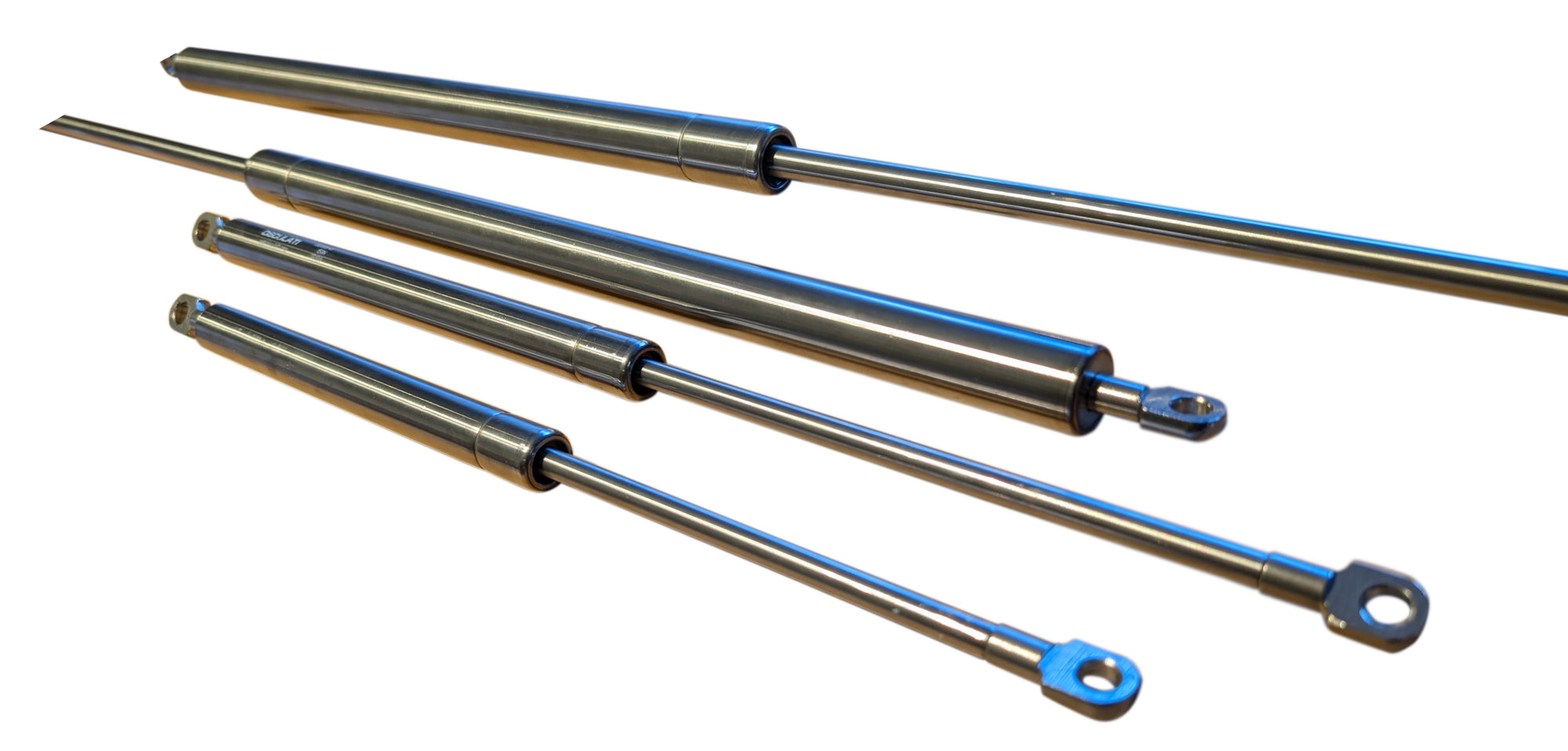
In this guide we will go through the key steps for selecting and installing our stainless steel gas struts, for engine covers, hatches and other heavy closures. We start with an explanation of how gas struts work, and then go on to explain the important parameters when selecting a gas struts.
We then go on to look at a worked example based on a customer enquiry. Here we look at the initial geometry defined by the customer, and we go on to show the process of optimising the choice of gas strut and the mounting geometry to achieve the desired result.

We make use of a calculation tool that we have developed using Microsoft Excel. For anyone technical-minded we can make this available for your own projects.
A Short Description Of How Gas Struts Work
Gas struts (or gas springs) are basically a rod with a piston on the end running in a cylinder of compressed gas (usually Nitrogen). The compressed gas acts like a spring, so as the rod is pushed into the cylinder (ie making the gas strut shorter) the force goes up. There is also a small amount of oil in the gas strut which, in conjunction of very small holes in the piston, add damping to the gas strut so that its movement is smooth and controlled.

When installing a gas strut the cylinder end should be uppermost in the assembly, this is so that during the operation of the gas strut the piston will make contact with the oil.
When defining or choosing a gas strut there are some key parameters as follows:
- Length: This is the extended length of the gas strut (from centre to centre)
- Stroke: This is the distance that the gas strut can compress during operation
- Compressed Length: This is the [extended length] - [stroke]
- Nominal force (when extended): This is the amount of push that the gas strut has at full length
- Force when compressed fully: This is the amount of push that the gas strut gives at its shortest length
We have a wide range of gas struts (more than 50 options) with varying combinations of the parameters above. Choosing which gas strut is suited to your need is a little complicated. It involves taking all of the above parameters into account, but also the geometry and weight of your hatch, and the location of each end of the strut (or stuts as it is usual to use 2). Don't worry though - we are here to help, and you may well find all the information you need in this guide.
Filtering To Help Narrow Down Your Selection
Just to note though, with so many gas strut options to look at, on our website within the gas strut category you can use our quick filters to narrow down your selection to look at.
In the example screen shot below, we are in the gas struts category, here we have filtered all gas struts with a length of 500mm, and now we are looking at filtering the force, which can narrow down our selection further.

We will come back to this later.
Replacing Worn-Out Gas Struts
It may be that you are looking to replace some existing gas stuts. Over time gas struts can degrade, either going rusty or losing some of their force due to gas escaping over time. It is quite common to find that after a few years, your gas struts that used to do a great job of lifting your hatch, now struggle to provide enough force for the job (especially in cold weather).
The first thing to check is the extended length of your existing gas strut, to find a close match. If you then examine your existing struts you will hopefully find some labelling (either on a sticker or etched onto the cylinder) which defines the nominal force of the gas strut.
Below is an example showing the force specified on one of our gas struts.

The key part of the labelling in the photograph above is the 300N which indicates a nominal force of 300 Newtons, which is equivalent to approximately 30kg - just divide by 10 (9.81 if you want to be strictly correct) to convert Newtons to kg force.
If you can't find any indication of force level on your existing gas strut, you may be able to determine its current force by pushing the gas strut down onto some bathroom scales, making sure you push enough to get some movement of the strut. If you use this method (and your existing strut is not giving enough force) you will, of course, have to estimate what additional force you want from your replacement strut(s).
Type Of End Fittings
Our gas struts come with a choice of end fittings, either plain end bearings, or ball-ended fittings.

The plain end bearings have an 8mm plain hole. The ball-ended fittings fit onto a 10mm diameter ball fitting, being secured with a spring clip. We have a range of gas strut end mounting brackets to suit either of these styles of end fitting.
The plain end fittings are suitalbe for situations where the gas strut is mounted in-line. It is generally best to keep the gas strut installation as 'in line' as possible, but sometimes that is tricky due to the constraints of your hatch or surrounding structure. If it turns out that (when viewed from above) the gas struts need to be at an angle (keep this to a minimum) then choose ball-ended struts and mounting brackets.
Customer Enquiry - Worked Example
A customer wanted to install a pair of gas struts for a locker hatch on his boat. The customer gave a good sketch of the locker geometry, and an initial idea of what they had in mind for the gas strut (force, length and geometry):
Closed Geometry

Open Geometry

Some key information from the initial customer sketches:
- Length of hatch 500mm
- Weight of hatch 13kg (customer weighed one end at 6.5kg)
- Open length of strut 455mm
- Closed length of strut 275mm
- Intention is to have a pair of struts for a balanced system
In general the desired behaviour is that when the hatch is in its closed position, the weight of the hatch overcomes that force in the gas strut, so the hatch stays closed. A significant force is needed to pull up the hatch and start it opening. Part way through opening, the force balance changes and the hatch reaches a self-opening point, and it will continue to open un-aided (the damping built into the gas strut keeps this in a smooth and controlled way). When the hatch reaches its fully open position (with the gas strut at its maximum extension) it stays open and needs a significant force to start it closing.
Achieving this behaviour needs careful attention to the geometry of each end of the gas strut, relative the the hatch hinge point.
Using our calculator tool, the diagram below represents the initial geometry given for the hatch and gas strut mounting points.

As well as the geometry, we must enter the characteristics of our chosen gas strut. In this example we are looking at our gas strut with part number SM-2011. Below is a screen shot from our website, given in the second image for this part.

The key data is entered into our calculator tool as show below:

The screen shot blow shows the progression as the hatch is opened. The yellow arrow and adjacent number indicate the force needed (by the operators hand) to maintain equilibrium. A positive number indicates that the operator needs to be pulling that hatch open, a negative number indicates that the operator needs to be restraining the hatch from opening (or pushing it towards closed).

It can be seen that the customer's starting geometry does not function well. This is because, with the fairly vertical orientation of the gas strut, the hatch would always want to open itself. What we are wanting instead is that when the hatch is fully closed, the opening action of the gas struts is not quite enough to overcome the weight of the hatch.
After some geometry optimisation we arrive at a system which functions well, shown by the images below:

With this preferred geometry we can see that the lower mounting point of the strut is vertically much closer to the hatch hinge point (this is typical of what is required). Studying the yellow force arrows are can see that from the closed position, the operator must pull up with around 3kg force to start the hatch opening. At around 50-degrees open we reach more or less a point of equilibrium where the hatch is about to become self-opening. At the fully open position (which corresponds to the gas strut reaching its maximum length) the force in the strut exceeds the gravitational force acting to try and close the hatch. In order to close the hatch the operator will need to push around 3kg to start it closing. This is a perfect situation.
To view our range of gas struts click <here>
If you would like some help with your gas strut selection, or would like to work with our gas strut calculator then please get in touch with us <here>